

 my account
Does your child see clearly in class? 3 signs of myopia to watch for
Does your child sometimes squint to see the board at school? Do they sit very close to books or the television? While these behaviours can have different causes, they may also be among the first signs of childhood myopia (nearsightedness).
What is myopia in children?
Myopia, commonly known as nearsightedness, is a vision condition that makes distant objects appear blurry. A child with myopia can usually see clearly up close but may have difficulty seeing the whiteboard at school or objects in the distance.
Because myopia often progresses gradually during childhood, it can go unnoticed for some time. Today, some solutions not only correct vision but may also help slow the progression of myopia. The younger myopia develops, the more likely it is to progress over time, which may increase the risk of certain eye health complications later in life.
This is why regular eye examinations are recommended throughout a child's school years.
3 signs to watch for
1. Your Child Often Squints
When a child tries to see something in the distance, such as the classroom board or a sign across the room, they may instinctively squint. While this behaviour does not automatically mean they are myopic, it is worth paying attention to.
Watch for:
- Squinting to see things far away.
- Frequent frowning when looking at distant objects.
Complaints that words or images appear blurry.
2. Your child constantly moves closer to screens or books
Children sometimes naturally sit close to what they are looking at. However, if this becomes a consistent habit, it may be worth having their vision checked.
Watch for:
- Sitting very close to the television.
- Holding a tablet or book unusually close to their face.
Leaning in excessively when doing homework.
3. Your child sometimes has headaches after school
Fatigue, screen use, or lack of sleep can all contribute to headaches. While it is important not to jump to conclusions, some symptoms may justify scheduling an eye examination.
Watch for:
- Frequent eye strain.
- Recurring headaches.
- Frequent eye rubbing.
When should you consult an optometrist?
If you notice one or more of these behaviours, an eye examination is a good first step toward understanding what may be causing them. The goal is to ensure your child has the best possible visual conditions to learn, develop, and enjoy everyday activities.
My child is not myopic. Are they still at risk?
Some children have factors that may increase their likelihood of developing myopia. For example, a child whose two parents are myopic may be up to six times more likely to develop myopia than a child whose parents are both emmetropic.1
What if myopia is confirmed?
When myopia is diagnosed, the goal is not only to provide clear vision but also, when possible, to help limit its progression.
Your optometrist may recommend different options to help manage myopia progression. Depending on your child's needs, these options may include spectacle lenses specifically designed for myopia management, such as Essilor® Stellest® lenses.
Unlike standard single-vision lenses, which only correct vision, Stellest® lenses are designed to provide clear vision while helping to slow myopia progression. They incorporate a technology that creates a signal intended to help slow eye elongation, one of the main factors associated with myopia progression in children. Clinical studies have shown an average reduction in myopia progression of up to 67% when Stellest® lenses are worn regularly.2,3
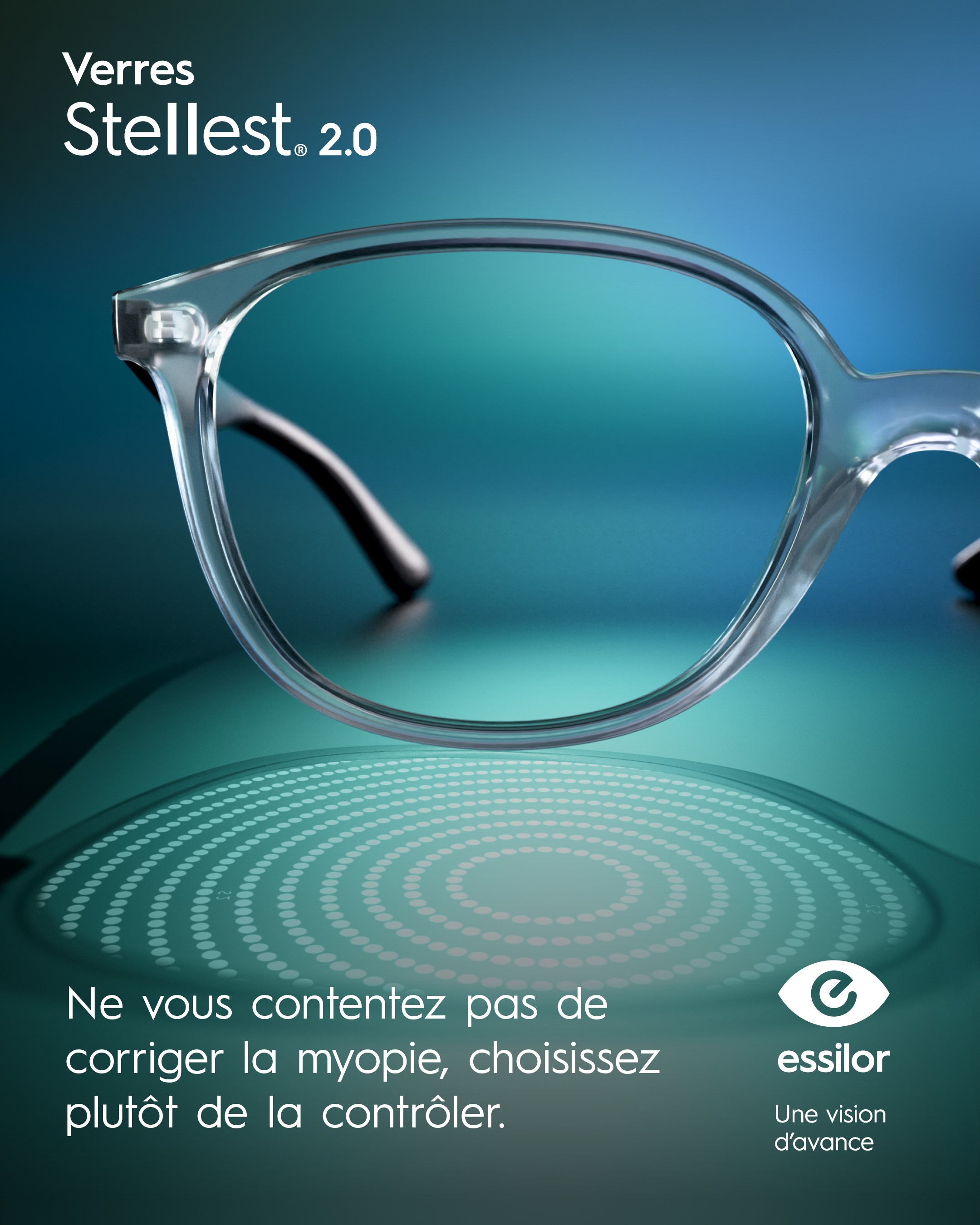
Technology continues to evolve. Essilor® Stellest® 2.0 lenses, powered by H.A.L.T.* MAX technology, demonstrated eye elongation, the primary cause of myopia progression, that was 1.88 times slower than with the previous generation of Stellest® lenses.† This innovation is designed to provide an even more effective approach to myopia management in children.
Sometimes a simple concern is worth checking
At Opto-Réseau, our eye care professionals support your family every step of the way, from vision assessment to correction options and myopia management strategies when needed. If you have any concerns, do not hesitate to contact your local clinic team.
1. Compared with a child whose two parents are emmetropic. Pacella R. et al. Role of genetic factors in the etiology of juvenile-onset myopia. Opt Vis Sci. 1999;76:381-386.
2. Compared with single-vision lenses when worn 12 hours per day, every day, for two consecutive years.
3. Bao J. et al. Spectacle lenses with aspherical lenslets for myopia control vs single-vision spectacle lenses. JAMA Ophthalmology. 2022;140(5):472-478.
* H.A.L.T.: Highly Aspherical Lenslet Target.
† Based on the 12-month results of a prospective, randomized, double-masked, crossover clinical trial conducted in Singapore involving 50 myopic children. Estimated cumulative axial elongation over 12 months was 0.228 mm with Essilor® Stellest® lenses and 0.121 mm with Essilor® Stellest® 2.0 lenses. The 1.88× ratio reflects the relative difference between these two values (1 ÷ [0.121 ÷ 0.228] = 1.88).
† Reference: Raveendran RN et al. Effect of increased power and asphericity of highly aspherical lenslets on myopia control efficacy: a contralateral crossover study. Transl Vis Sci Technol. 2025;14(11):9.