

 my account
Why combine glasses and contact lenses?
Life demands more from our eyes. Increased use of digital devices, challenging lighting conditions, and exposure to blue-violet light from screens, fluorescent lamps, and the sun make it essential to choose a complete and flexible visual solution that suits every moment of the day.
Wearing both in daily life
Switching between glasses and contact lenses throughout the day means choosing flexibility and comfort for your eyes. In the morning, many people prefer glasses while working from home or in front of a computer, enjoying visual comfort and protection from blue light.
By midday and afternoon, contact lenses take over for physical activities, outings, or social events: 81% of dual wearers prefer lenses for sports, and 64% for going out with friends.
In the evening, some switch back to glasses to rest their eyes or avoid dryness after a long day.
This “dual wear” lifestyle allows you to adapt your vision correction to each moment, based on your needs and preferences.
It’s also a way to maximize comfort, performance, and eye health—while enjoying the best of both worlds.
Glasses and Contact Lenses: A Winning Combination
Wearing both glasses and contact lenses offers many benefits.
Glasses remain essential for protecting your eyes from UV rays and for moments of rest.
Contact lenses provide freedom of movement and optimal peripheral vision—ideal for sports or social activities.
According to a study by the Contact Lens Institute, the complementarity between glasses and contact lenses meets all visual needs while maximizing comfort and eye health. For example, it’s recommended to wear UV-protective sunglasses even when using UV-filtering contact lenses, as lenses don’t fully cover the eye and its surrounding area.
Nearly one in four adults (24%) who use vision correction wear both glasses and contact lenses.
- 81% of dual wearers prefer contact lenses for sports or physical activities, and 33% have increased their use of lenses for these activities over the past year.
ACUVUE®OASYS MAX 1-jour: MAX Comfort. MAX Clarity*
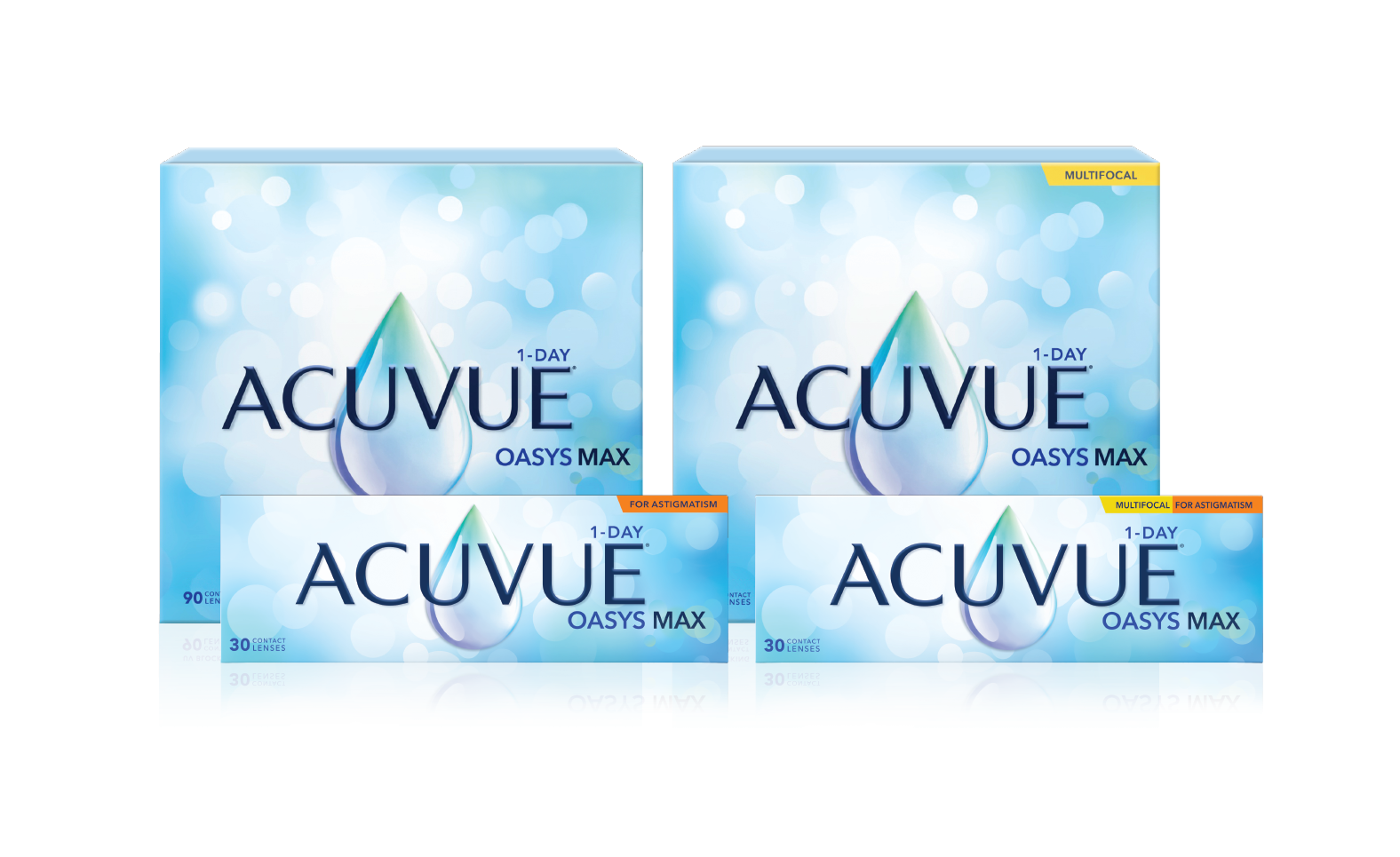
ACUVUE® OASYS MAX 1-Day offers the ideal balance between glasses and contact lenses for everyday life.
An unprecedented combination of technologies brought together in a contact lens that delivers all-day comfort and visual clarity—day and night.
It’s designed to retain moisture, reduce halos* and starbursts*, and provide the highest level of blue-violet light filtering †‡ as well as the highest class of UV protection# ^.
To learn more, visit the Acuvue website
https://www.acuvue.com/en-ca/oasys-max/
Our tips for optimal use
- Alternate between glasses and contact lenses depending on your activities and environment.
- See your eye care professional regularly to adjust your prescription and choose products suited to your needs.
- Follow the recommended wear and replacement schedules for your lenses, as well as care instructions.
- Always keep an up-to-date pair of glasses for times when contact lens wear is not recommended.
Sources
- Johnson & Johnson Vision, 2023. Document d’information destiné aux consommateurs sur les lentilles cornéennes ACUVUE(MD) OASYS MAX 1-jour, incluant les mises en garde réglementaires et les recommandations d’utilisation.
- DOUBLE DUTY: THE PATIENT AND PRACTICE POTENTIAL OF DUAL CONTACT LENS & GLASSES WEAR
Contact Lens Institute, Spring 2023. Rapport d’étude sur le port combiné de lunettes et de lentilles cornéennes, basé sur une enquête auprès de consommateurs et de professionnels de la vue en Amérique du Nord. - OptikNow, 2025. Article publié sur le site OptikNow, présentant les avantages du port combiné et les tendances observées chez les porteurs de lunettes et de lentilles au Canada.
Footnotes:
• * Compared to ACUVUE® OASYS 1-Day.
• † It has not been demonstrated that HEV light filtering by contact lenses provides any health benefit to the user, including but not limited to retinal protection, protection against cataract progression, reduction of eye fatigue, improvement of contrast or acuity, reduction of glare, improvement of low-light vision, circadian rhythm, or sleep cycle. Consult an eye care professional for more information.
• ‡ Compared to publicly available information on standard daily disposable contact lenses as of June 2023.
• # Helps protect against the harmful effects of ultraviolet radiation on the cornea and the eye.
• ^ WARNING: UV-blocking contact lenses are not substitutes for UV-blocking eyewear such as UV-blocking goggles or sunglasses, as they do not completely cover the eye and surrounding area. Continue to use UV-blocking eyewear as directed. NOTE: Long-term exposure to UV radiation is a risk factor associated with cataracts. Exposure depends on a number of factors such as environmental (altitude, geography, cloud cover) and individual (duration and nature of outdoor activities). UV-blocking contact lenses help protect against the harmful effects of UV radiation. However, clinical studies have not demonstrated that wearing UV-blocking contact lenses reduces the risk of developing cataracts or other eye disorders. Consult an eye care professional for more information.